Ever wonder how a car gets from a factory floor to a dealership lot hundreds of miles away? It doesn’t just drive there. There’s a whole system behind it, and it’s a lot more complicated than people assume.
This is where OEM auto transport comes in.
Let’s break it down.
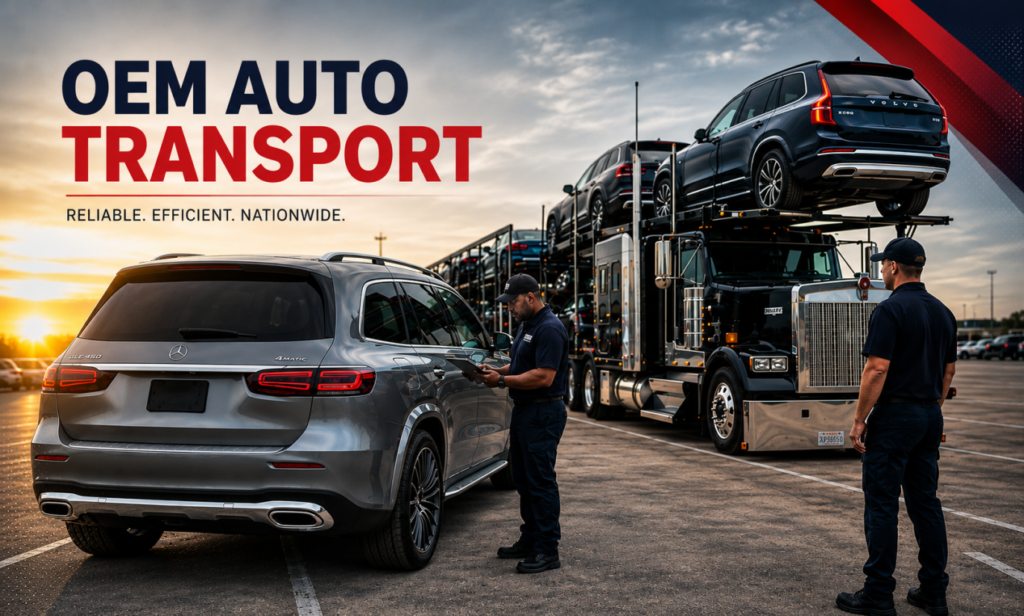
OEM stands for “original equipment manufacturer.” So OEM auto transport basically means moving vehicles directly from the manufacturer — think factories, assembly plants, production hubs — to dealerships, distribution centers, or sometimes even directly to fleet buyers.
It’s not the same as regular car shipping. Not even close.
Here’s why it’s different:
A car company can’t just call a random trucking service every time a batch of vehicles rolls off the line. That would be chaos, honestly.
Manufacturers need:
Miss any one of these, and things fall apart fast. A delayed shipment isn’t just annoying — it can mean a dealership sitting empty-handed during a busy sales weekend.
So how does a car actually move from factory to dealer lot? It’s not one giant leap. It’s several smaller stages.
For international manufacturers, there’s often an extra layer — ocean freight or rail, followed by inland trucking once vehicles reach a port or border hub. That adds complexity, and honestly, a lot more paperwork too.
Both, actually. It depends on distance and cost.
Many manufacturers use a hybrid approach. Rail gets vehicles most of the way, then trucks handle the “last mile” to individual dealerships. It’s a balance between cost efficiency and speed, and honestly, most big auto brands rely on this combo more than people realize.
It’s not always smooth. A few recurring headaches:
None of these are deal breakers on their own. But stack a few together, and a manufacturer’s whole distribution schedule can get thrown off.
For a regular person shipping one car, a delay is inconvenient. For a manufacturer? A delay in OEM auto transport can ripple across an entire supply chain. Dealerships miss sales windows. Inventory piles up at the wrong location. Customers waiting on a specific model get pushed back weeks.
That’s why manufacturers usually work with dedicated logistics partners who specialize specifically in large-scale vehicle movement, not general freight companies handling random cargo.
OEM auto transport isn’t glamorous. Nobody really thinks about it until something goes wrong — a late shipment, a damaged vehicle, an empty dealership lot. But behind every new car sitting on a showroom floor, there’s a whole logistics operation that got it there safely, on time, and (hopefully) without a scratch. A: Manufacturers use protective wraps, secure tie-down systems, and careful loading sequences to minimize the risk of scratches or damage during transit. A: Both, actually. Rail is common for longer distances due to lower cost, while trucks handle shorter routes or the “last mile” from rail hubs to dealerships A: Dealerships inspect vehicles on arrival. If damage is found, a claims process usually starts between the manufacturer, dealership, and transport carrier to determine responsibility. A: General freight companies aren’t specialized for large-scale vehicle movement. Manufacturers typically prefer dedicated logistics partners experienced specifically in OEM auto transport to reduce delays and damage risks.
Q: How are vehicles protected during transport?
Q: Do manufacturers use rail or truck transport more often?
Q: What happens if a vehicle is damaged during transport?
Q: Why don’t manufacturers use general freight companies?