
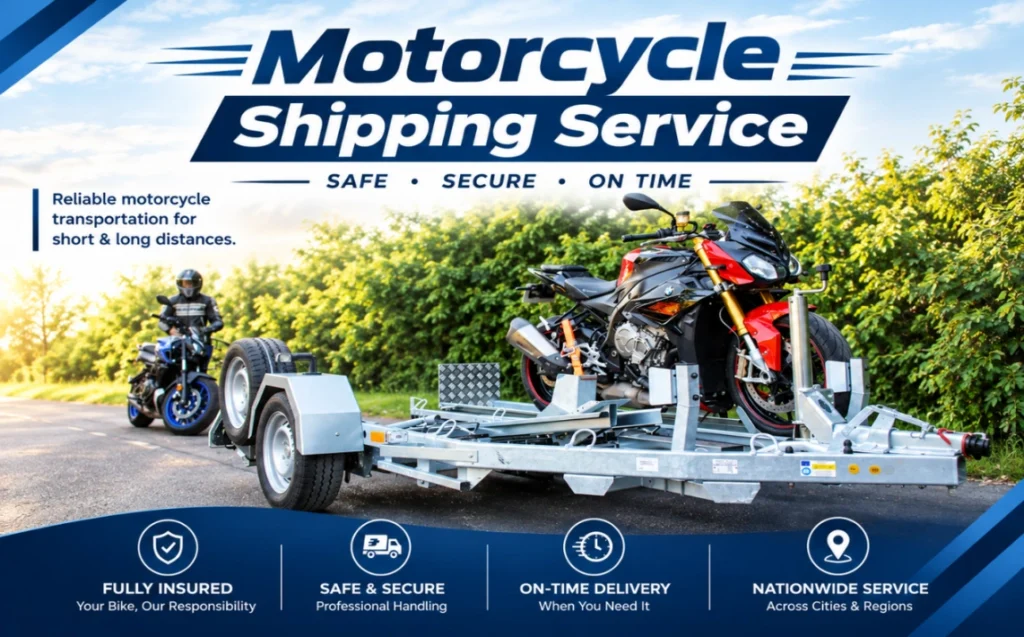
Selling a bike to a buyer three states away? Do you want to avoid travelling 1,800 miles on the highway when moving across the country? This is where motorcycle shipping comes in, and to be honest, most people don’t know how it operates until they need it.
Let’s make that right.
The problem with motorbike shipping is that, despite popular belief, it’s not the same as shipping a car. Yes, bikes are lighter. They’re less stable, though. No four-point contact with the earth. That completely alters the way they are secured for transportation.
One of two configurations is used by most services:
Your money and your level of concern for your bike’s cleanliness will largely determine which one you choose.
The logistics of motorcycle transport are consistently underestimated. It’s not as simple as “strap it down and go.” A bike that is equipped correctly requires:
You run the danger of damage if you skip any of these stages, including bent forks, tilted motorcycles, and scratched tanks. After the fact, speaking with a shipping business is not enjoyable.
The methods used by different motorcycle transport service providers vary. Some people focus just on motorcycles. Others, along with vehicles and general freight, see motorcycles as an afterthought.
Specialists are typically worth the additional expense, primarily because:
For regular bikes on short journeys, general freight firms can also function well. However, specialisation is more important than most people realise for anything high-end, vintage, or custom.
In all honesty, the majority of issues arise or are completely avoided when choosing a motorcycle shipping company. A few warning signs to be aware of:
Conversely, reputable businesses often provide upfront pricing with no unexpected add-ons at delivery, realistic schedules (not abnormally quick), and clear insurance documents.
Many first-time shippers are confused by this. A motorcycle transport company may not be the actual carrier transporting your bike, but rather a middleman. Is that a terrible thing? Not always.
Transport is arranged by brokers via a network of carriers. In fact, you may benefit from more flexible scheduling and competitive pricing. Accountability is the catch. You want to know if the broker or the carrier they selected is ultimately accountable if something goes wrong.
Ask yourself: “Are you the carrier, or are you brokering this to someone else?” A reputable business will respond right away.
A common misconception is that motorcycle movers are only used for cross-country relocation. It’s untrue. Even for shorter distances, professional transportation is necessary in many situations:
The deciding issue isn’t really distance. Practicality and risk are.
You should be guided through a reasonably standard procedure by a good motorcycle delivery service:
The inspection phase is really crucial. Any insurance claim will go much more smoothly if damage is reported right away, with the driver present. Conflicts are far more difficult to settle when you wait until after the driver has left.
The same question comes up for everybody looking into nationwide motorcycle shipping: Why do quotations differ so much in price?
Cost is influenced by a few factors:
Cross-country shipping typically costs between $400 to $1,000 or more, though this varies frequently depending on carrier capacity and fuel rates.
The final point to consider is the difference between terminal-to-terminal and door to door motorcycle shipping.
Convenience Options | Door-to-Door | Terminal-to-Terminal |
Convenience | High – delivery to and from your address | Lower: You take a car to a depot |
Cost | A little more expensive | Typically, less expensive |
Scheduling | Flexibility in scheduling and more accurate timing | Unpredictable time |
Best For | Ideal for the majority of residential clients | Shippers on a tight budget close to depots |
Since most individuals don’t live close to a shipping facility and organising a separate pickup trip adds effort that most people would prefer to avoid, door-to-door is typically the more popular option.
Depending on the distance, carrier route efficiency, and weather, cross-country journeys often take five to ten days. Regional routes that are shorter can only take one to three days.
Although coverage amounts and terms vary, reputable carriers offer cargo insurance. Prior to making a reservation, always get evidence of insurance and be aware of the deductible.
For safety reasons, the majority of carriers mandate that the tank be no more than a quarter full. Always get particular requirements confirmed in advance with the company of your choice.
Although it is less expensive, open shipping exposes the bike to weather and road debris. For expensive or vintage bikes, enclosed shipping is worth the extra money because it completely protects the bike.
Yes, the majority of businesses are able to accommodate non-running bikes; however, the cost may somewhat increase if special loading equipment, such as a winch, is needed.
It is usually advised to make reservations one to two weeks in advance, particularly during the busiest time of year (spring through summer), when both demand and prices tend to increase.