So you need to ship a car. Great. Now comes the annoying part — picking between open transport and enclosed auto transport. Everyone online says something different. One site swears open is “totally fine.” Another insists enclosed is the only “safe” option. Truth is, both are safe. The real question is what YOUR car needs, and what YOUR budget can handle.
Let’s break it down without the sales pitch.
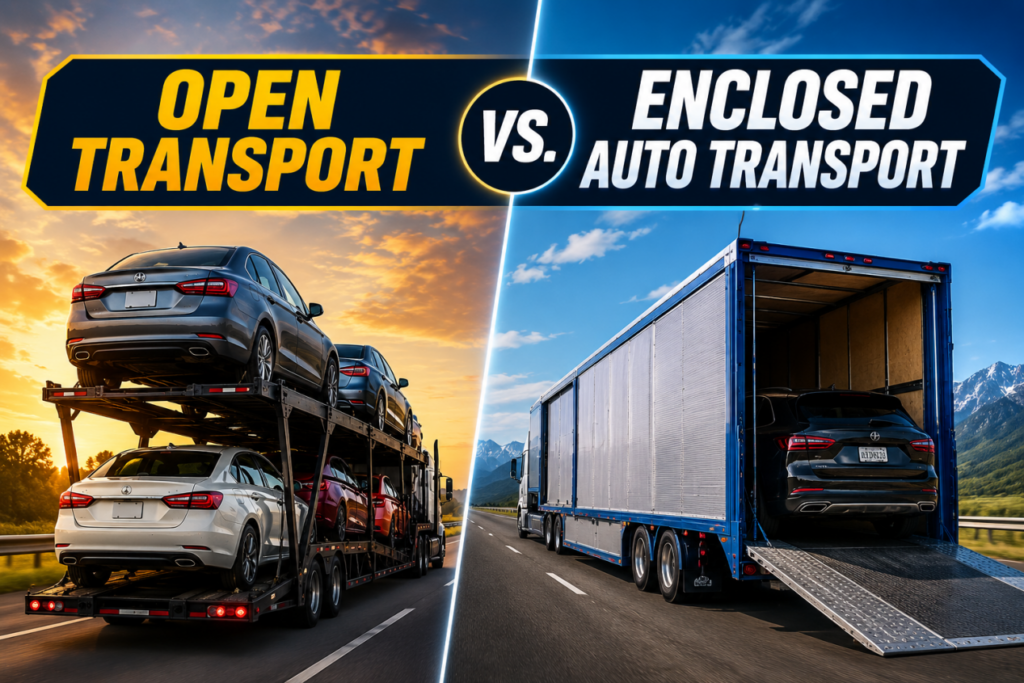
Picture a two-level trailer hauling seven to ten cars at once, fully exposed to the sky. That’s open car shipping. It’s the method dealerships use to move inventory. It’s what rental companies use. It’s what most everyday people use when they relocate.
Why? Because it’s cheap, it’s fast, and there’s a huge fleet of open carriers on the road at any given moment. Roughly nine out of every ten vehicles shipped in the U.S. move this way. That’s not a small number that’s the entire backbone of the auto transport industry.
Pros of open transport:
Cons:
Now imagine a fully covered trailer hard-sided or soft-sided carrying just two to six vehicles. That’s enclosed transport. No weather. No flying gravel. No curious strangers peering in at a stoplight while your car sits exposed on a rig.
This method exists for one simple reason: some vehicles cannot tolerate the exposure that comes with open shipping. Think classic cars. Exotic cars. Brand-new luxury vehicles with sensitive paint or fragile trim. Low-riders that can’t handle rough loading ramps.
Pros of enclosed shipping:
Cons:
Here’s the number that matters most. Enclosed transport typically runs 30% to 60% more expensive than open transport for the same route. That’s not a small gap it can mean an extra $400 to $700, sometimes more, depending on distance and vehicle size.
A rough real-world example: a 500-mile trip might land around $650 on an open carrier. The same trip enclosed? Closer to $1,000. That gap matters more for certain cars than others high-end EVs, for instance, benefit from the extra shielding against weather and road debris that can affect paint finishes and exterior sensors.
For longer, cross-country hauls, open transport generally lands somewhere in the $550 – $1,200 range. Enclosed for the same trip? Expect $900 – $2,400. Big spread, yes but that’s auto transport pricing for you. Distance, vehicle weight, current demand, even the season all push the number around.
Quick gut-check: if your quote feels “too good,” ask why. A too-cheap quote sometimes means an unlicensed or overbooked carrier. Always verify a company’s FMCSA registration before booking it takes two minutes and can save you a massive headache.
Ask yourself three quick questions.
For most people regular sedans, SUVs, trucks, minivans open transport is the practical, budget-friendly choice. It’s reliable. It’s proven. Millions of cars move this way every single year without issue.
But if you’re shipping a car that would make your stomach drop at the sight of a single scratch, enclosed transport isn’t a luxury it’s just common sense.
Fewer vehicles per trailer, higher insurance requirements, and a smaller pool of specialized carriers. Less capacity plus more coverage equals a higher price tag.
Sometimes. Many comprehensive policies do cover transport damage, but not all. Call your insurer and ask directly before assuming you’re covered.
Generally, no. Most carriers won’t insure personal belongings, and extra weight can cause safety or loading issues. Keep the car empty except for factory equipment.
Check their FMCSA registration and MC number through the official FMCSA search portal. A real company will have this info ready and easy to find.
Usually not. Unless you’re in a high-risk weather corridor or just want maximum peace of mind, open transport does the job for regular vehicles.
Yes. It’s the industry standard for a reason.
Millions of vehicles ship this way every year with no issues. Minor weather exposure
is the main trade off, not major damage.